Why “better habits” can feel harder than expected
The day you decide to “do better” is often the same day your patience feels thinner. You go to bed earlier, and suddenly your mind is louder. You pack a lunch, then forget to eat it until you’re already irritable. It can feel confusing—like the routine is failing—when what’s really showing up is how much your system has been running on quick fixes.
In real life, better habits don’t land on a blank slate. They collide with uneven sleep, long gaps between meals, and the steady drip of messages and noise. When your body is under-fueled or overtired, stress hormones and blood sugar swings can make emotions spike faster, so a small frustration reads like a bigger threat. The “hard” part isn’t lack of willpower as much as a stress–fatigue loop that’s been quietly practicing itself for months.
A single good night doesn’t erase a week of late nights, and cutting back caffeine might briefly reveal how tired you actually are. Many people interpret that dip as proof they “can’t stick to routines,” when it may simply be the adjustment period where your baseline becomes easier to notice.
Spotting emotional triggers hidden in daily routines

You notice it in the small moments: the snap in your voice when someone asks a normal question, the tightness in your chest when the calendar alert pings, the sudden urge to “just handle it later.” A lot of people assume that means they’re becoming more emotional. Often, it’s more like the day has been quietly draining their buffer—little withdrawals that don’t feel dramatic until something minor tips it over.
Hidden triggers tend to be ordinary. A late coffee that doesn’t feel like “too much” until bedtime slides an hour. A skipped breakfast that turns into a bigger lunch, then a mid-afternoon crash that feels like anxiety. A glass of wine that takes the edge off, but makes sleep lighter, so the next morning starts with less patience. None of these are moral failures. They’re patterns that can nudge stress hormones, hunger cues, and attention in ways that make the world feel sharper.
What helps is noticing the repeatable sequence, not the single bad moment. If your mood shifts reliably after long stretches of sitting, after scrolling in bed, or after back-to-back meetings with no pause, that’s useful information—even if you can’t fix it perfectly. The goal isn’t to track every feeling, just to catch the early signs that your routine is running you, not supporting you.
Stability habits that reduce decision fatigue and reactivity
It usually shows up mid-afternoon: you’ve answered a dozen small questions, your shoulders are up near your ears, and choosing what to eat feels oddly exhausting. That’s decision fatigue mixed with a body that’s been running on partial inputs. When sleep timing shifts, meals get delayed, and breaks become “later,” the nervous system stays on a light simmer—so the next interruption lands like a shove.
Stability habits aren’t glamorous, but they reduce the number of daily judgment calls your brain has to make. Similar wake and bed windows (even if not perfect), predictable fuel every 3–5 hours, and a short “transition” between work and home can keep blood sugar and stress signals from spiking as hard. It’s not that life gets calmer; it’s that your internal cues stop getting drowned out.
The most stabilizing routines can feel restrictive at first. Turning off notifications for an hour may initially make you more aware of restlessness. Eating earlier can reveal how long you’ve been pushing through hunger. If the pattern continues, that discomfort is often a sign you’re relearning your baseline, not doing it wrong.
Connection practices that feel supportive, not performative
It can be strange how a quick “How are you?” text makes you feel worse instead of better. You don’t want to dump your day on someone, but you also don’t have the energy to pretend you’re fine. Many adults end up doing a kind of social multitasking—replying fast, keeping it light, staying “on”—and it looks like connection from the outside while your body still feels alone with the load.
Supportive connection usually lands differently in the nervous system. It tends to be specific, paced, and mutual—more like a small exhale than a performance. A brief voice note, a five-minute check-in where you name one real thing, or sitting near someone without filling every second can lower that background vigilance. When contact is mostly reactive (notifications, group chats, workplace pings), it can keep stress signals running, even if you’re “talking to people” all day.
Sometimes the most realistic version is low-effort and repeatable: one person who gets a weekly walk, a short goodnight exchange that doesn’t turn into problem-solving, or a boundary that protects downtime so you’re not reaching out only when you’re already depleted.
When self-reflection backfires into rumination or anxiety
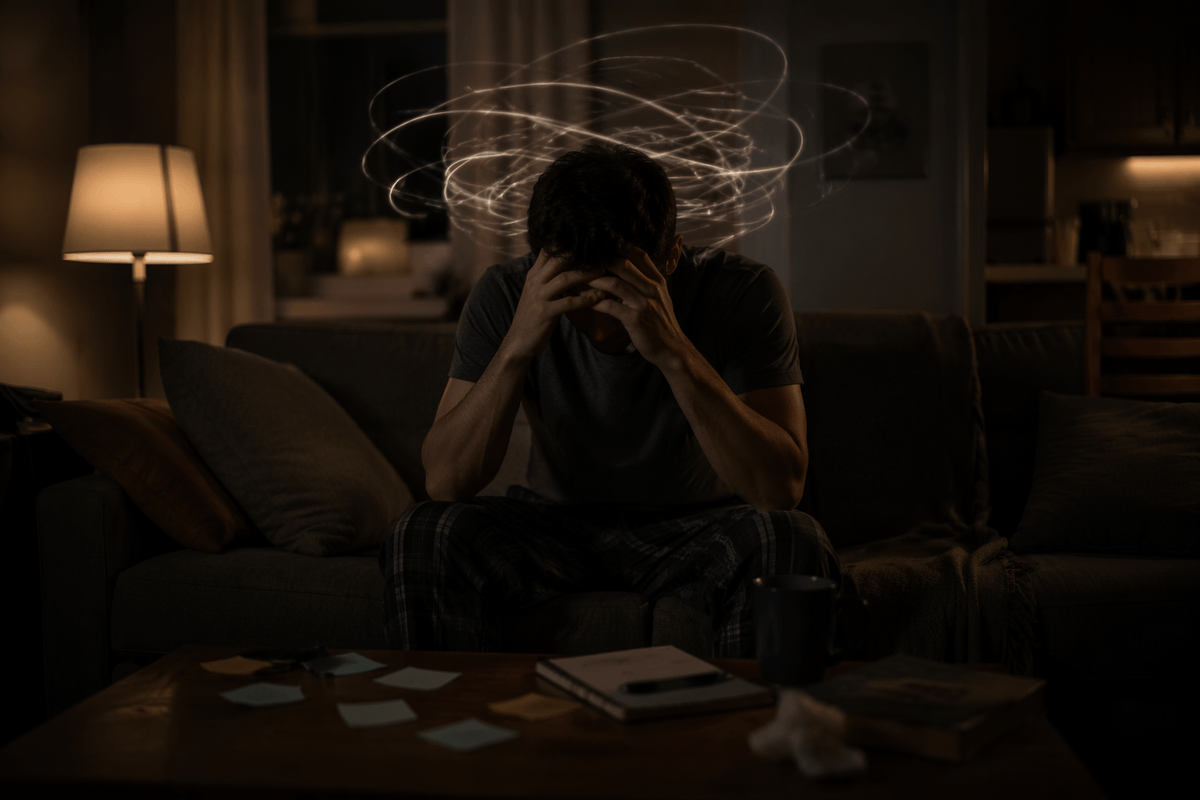
Sometimes it happens right when the house finally gets quiet: you sit down to “check in” with yourself and, instead of relief, your mind starts pulling up a highlight reel of everything you said wrong, forgot, or still haven’t fixed. It can feel like reflection is making you more anxious, when what’s really happening is that your brain finally has enough silence to notice how revved up your body has been all day.
In a tired or under-fueled state, self-reflection often turns into problem-scanning. Stress chemistry narrows attention toward threat, so your thoughts loop on the same few worries, looking for certainty that isn’t available. If sleep has been light, caffeine has been propping you up, or you’ve been living on short breaks, even a neutral question like “Why am I like this?” can land like an accusation.
One common misunderstanding is assuming that more insight will automatically settle the feeling. In practice, “figuring it out” can become another task your nervous system tries to complete at night, keeping you alert. If the pattern continues, it may help to treat spiraling as a signal—less about your personality, more about your recovery getting thin.
Building habits around emotions without trying to control them
You catch yourself doing it without thinking: reaching for coffee the second you feel flat, scrolling harder when you feel restless, pushing through lunch because the irritation “shouldn’t be a big deal.” In the moment it feels like you’re managing your mood. But a lot of these moves are really attempts to mute a signal quickly, and they can teach your body that discomfort means “fix it now.”
Habits tend to work better when they sit beside the emotion instead of arguing with it. If you’re tense, a short walk or a glass of water isn’t a cure—it’s a way to give your nervous system a different input while the feeling runs its course. If you’re low, eating something steady doesn’t have to mean you’re “emotional about food.” It’s just reducing the blood sugar swing that can make everything feel heavier.
Some days a simple reset helps, and other days it barely moves the needle. That doesn’t mean the habit failed; it may mean the load was already high. Over time, the win is noticing sooner: “This is my body asking for fuel, quiet, or movement,” not proof that you need to control yourself better.
Making habits stick when life keeps changing
It’s often the week you finally find a rhythm that something shifts—your kid gets sick, a deadline lands, travel pops up, or sleep gets chopped into pieces. Then the old thought shows up fast: “See, I can’t keep anything going.” In practice, the habit didn’t disappear; the conditions changed, and your brain tends to treat that as failure instead of a normal recalibration.
What usually makes routines “stick” isn’t a perfect streak—it’s a small version that survives disruption. When stress rises, your nervous system pulls toward what’s quickest: later nights, longer scrolling, more caffeine, fewer real meals. That’s not you being careless; it’s your body chasing immediate relief. The quick relief often costs you steadiness the next day, so the stress–fatigue loop gets another chance to rehearse.
When life is unstable, it can help to watch for the earliest tell that you’re slipping: bedtime drifting past your window, the first skipped meal, the moment downtime turns into numb scrolling. Those are easier to adjust than the fourth day of running on fumes. The goal becomes “returning sooner,” not returning perfectly—and over time, that’s what starts to feel like stability.