Why Wimbledon feels harder than other sporting days
I hesitated the night before because Wimbledon isn’t just “turn up for a match” in the way a football game or an arena sport is. Your whole day hinges on one early decision—how you’re getting in—and once you choose wrong, it’s painfully hard to fix without losing hours. For a first-timer with only a day or two free, that decision pressure is what makes Wimbledon feel strangely high-stakes.
The difficulty isn’t the tennis; it’s the layers around it. There’s the Queue (which can be brilliantly fair, but demands time and comfort with uncertainty), the ballot/resale routes (more predictable, but you’re constrained by what you’re offered), and hospitality (efficient, but often priced like a splurge). Then inside, you’re managing micro-decisions: commit to Centre Court and accept you’ll see less variety, or roam and risk missing the “name” you came for. Add London transport timing, security lines, and weather that can flip from sun to drizzle in one set, and Wimbledon becomes less a single event and more a day-long logistics puzzle.
Tickets, queues, and entry: choosing your best route
At 6:15 a.m. I caught myself doing the math on the Tube: was I about to spend half my “one real Wimbledon day” standing still? That’s the first-timer fork in the road. If you only have 1–2 free days and you hate uncertainty, aim for a ticketed route (ballot/resale) even if it means you don’t choose the exact matchup. If you want the most “Wimbledon” story and can spare the morning, the Queue is genuinely orderly—but it asks for patience, weather tolerance, and comfort with not knowing which court you’ll land until later.
Here’s the clean decision framework: Queue = best value and atmosphere, worst for time control. Ballot/resale = best for predictability, but you’re locked into a court and time, and it’s easy to overfocus on “Centre” and miss the breadth. Hospitality = smoothest entry and least mental load, but it can swallow a mid-range budget fast, and you may feel oddly insulated from the scrappy, communal energy outside.
If you Queue, treat it like a morning shift: arrive early enough that you’re inside before the first balls are struck, and assume security and the walk to the gates will take longer than you’d think. If you’re ticketed, don’t show up at the last minute anyway—late arrivals don’t just miss tennis; they miss the easiest time to orient yourself, grab a program, and decide whether you’re committing to one court or setting up a roam-first day.
What to pack, wear, and know about rules

The first small panic was at the gate when I realised my “light” bag was still a bag—and Wimbledon security is efficient, but not the place to discover you’ve packed like you’re moving in. Keep it simple: a compact backpack, an empty refillable bottle, and a portable charger you can actually find quickly. A phone ticket (or confirmation email) is fine until your battery isn’t, and the Queue especially becomes miserable if you’re rationing power all morning.
Dress for two forecasts, not one. I went in under-dressed for wind and ended up buying an overpriced layer I didn’t love; the grounds can feel summery in the sun and suddenly cold in shade or drizzle. Shoes matter more than outfits—this is a lot of standing, shuffling, and walking between courts, and “smart” shoes turn into a mistake by mid-afternoon. Sunglasses and a cap help on bright days, but a small rain jacket beats an umbrella if you don’t want to be that person blocking sightlines in a crowded concourse.
Rules are mostly common sense, but the friction comes from assumptions: don’t bring glass, expect bag checks, and don’t plan on constant in-and-out freedom once you’re settled on a show court. If you want flexibility, pack so you can move fast and sit anywhere without rearranging your whole life every time a match pulls you to a different court.
Grounds game plan: courts, timings, and where to sit
I made my first wrong move five minutes after walking in: I followed the crowd toward the famous courts, then realised I hadn’t done the basic orientation—what’s already in progress, what’s about to start, and what I can actually access with my ticket. Wimbledon rewards a plan, but not a rigid one. If you’re on a grounds pass, the best tennis often isn’t where the signage is trying to lead you; it’s on the outer courts where you can get close, read the spin, and feel the speed in a way Centre Court distance can’t match.
Timing is the lever. Arriving early buys you choices: you can do a quick lap, clock which courts have manageable queues, and “bank” a good seat before the first wave of wanderers settles. Arriving late still works, but you’re more likely to spend your first hour standing behind three rows of people who are also “just checking” a court. I found it smarter to commit to one outer-court match first, then roam between changeovers; court-hopping mid-game looks efficient on paper, but in reality you lose time to foot traffic and bottlenecks.
Where to sit is less about the perfect view and more about how long you’ll last. Baseline seats feel dramatic, but you end up turning your head like you’re watching a metronome; side seats are kinder for long sets and make it easier to track patterns. If it’s hot, shade is a strategic asset—moving ten rows for cover can save your energy for the evening, even if the “better” seat is technically in the sun.
Food, drink, and Wimbledon traditions worth prioritising
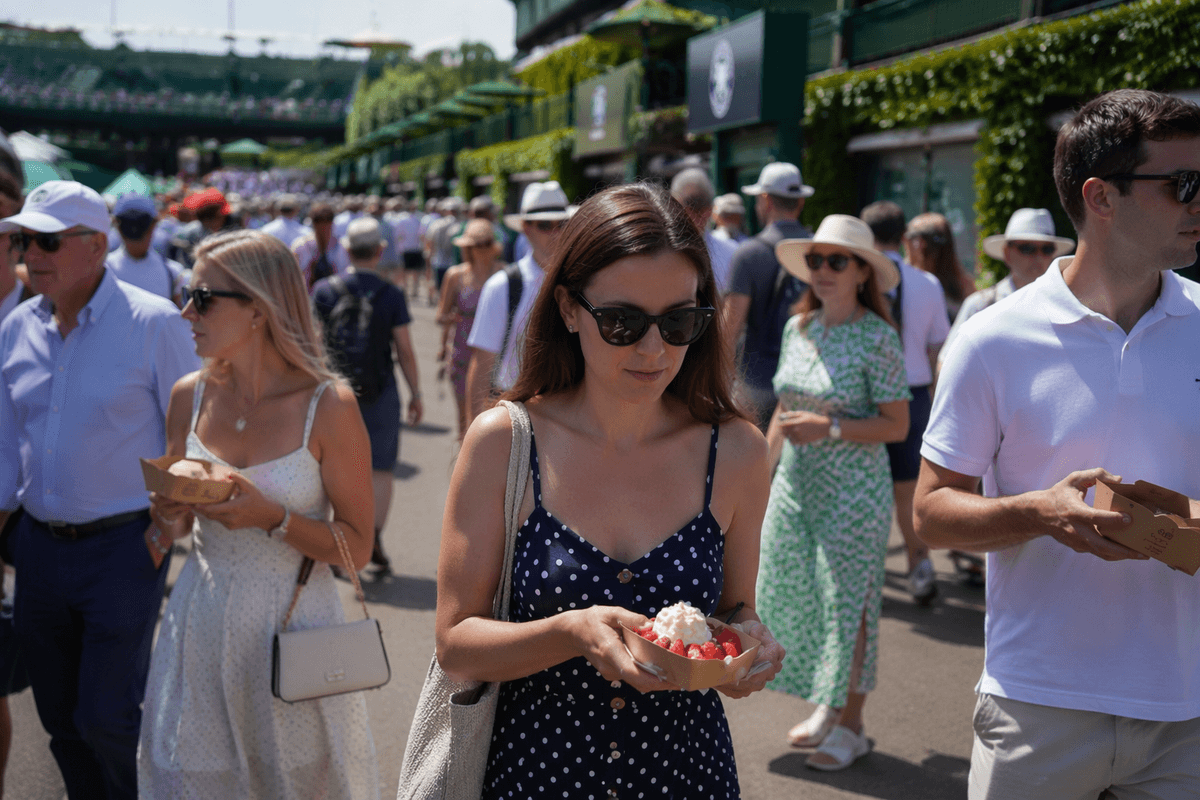
I felt the first real time-slip at about 1 p.m.: one tight set on an outer court turned into two, and suddenly I was hungry in a way that made every queue look twice as long. The mistake is waiting until you’re starving—food lines spike between matches, and if you’re trying to protect a good seat, disappearing for 30 minutes can cost you the rest of that court. I had better luck grabbing something earlier than I “needed,” then using changeovers for quick refills rather than a full lunch mission.
If you’re here for the traditions, prioritise strawberries and cream once, then move on—delicious, yes, but it’s not a meal and it melts into stress if you’re carrying it while weaving through crowds. Pimms is worth doing in the afternoon when you’re ready to slow down; earlier, it’s oddly risky if you still plan to court-hop efficiently. Water matters more than you think: refill whenever you pass a station, because hunting for it during a sudden hot spell is when Wimbledon starts feeling expensive and cramped.
Leave like a pro: memories, exits, and next time
The moment I started thinking about leaving was, annoyingly, the moment the day got easier—because Wimbledon doesn’t end when the last point does; it ends when you successfully rejoin London without an hour of slow shuffling. If you wait for the full post-match surge, you’ll get the atmosphere, but you’ll pay for it in a dense, stop-start exit where even finding the right direction feels harder than it should.
I found it cleaner to decide in advance what I wanted to “take home”: one last court to linger on, one final lap for the shop or a photo, then go. If you try to do all of it at the very end, you’ll rush and it won’t feel like a victory lap—just another queue. Next time, I’d pick my leave-time as deliberately as my entry route: not earliest, not latest, but with enough energy left that the day finishes on purpose.